
Learning words from Peppa Pig or Paw Patrol? Here's the vocabulary used in 5 children's shows
When parents debate whether Bluey is ‘better’ for language learning than Paw Patrol, or whether Peppa Pig is too simple, the discussion usually rests on intuition. This post takes a different approach. By analyzing transcripts from five popular shows for children, it reveals what each is actually offering in terms of words. Included are Peppa Pig, Bluey, Mickey Mouse Clubhouse, Paw Patrol, and Octonauts.
The analysis: How common are the words used in each show?
For the analysis, I used Lextutor’s Compleat VocabProfile, which is a standard reference in vocabulary research. It analyzes the words in a text or transcript and shows how common they are. This goes by ‘frequency bands’, from the most common 1,000 English words all the way up to the 25,000 band. For context, the word ‘good’ belongs to the top 1,000 words (very common), ‘flawless’ falls in the 4,000 band (less common), and ‘stellar’ in the 9,000 band (least common). Children usually learn the most common words first, and the more infrequent words follow with age.
The most common 2,000 English words cover roughly 95% of everyday conversation. We would expect children’s shows to not include many words beyond this level. At the same time, it’s good for material to offer at least some infrequent words, so children can expand their vocabulary.
Most common words: Peppa Pig
As we could expect, all five shows draw mostly from the most common 2,000 English words. Between 90% and 95% of each show’s dialogue sits within this everyday vocabulary range.
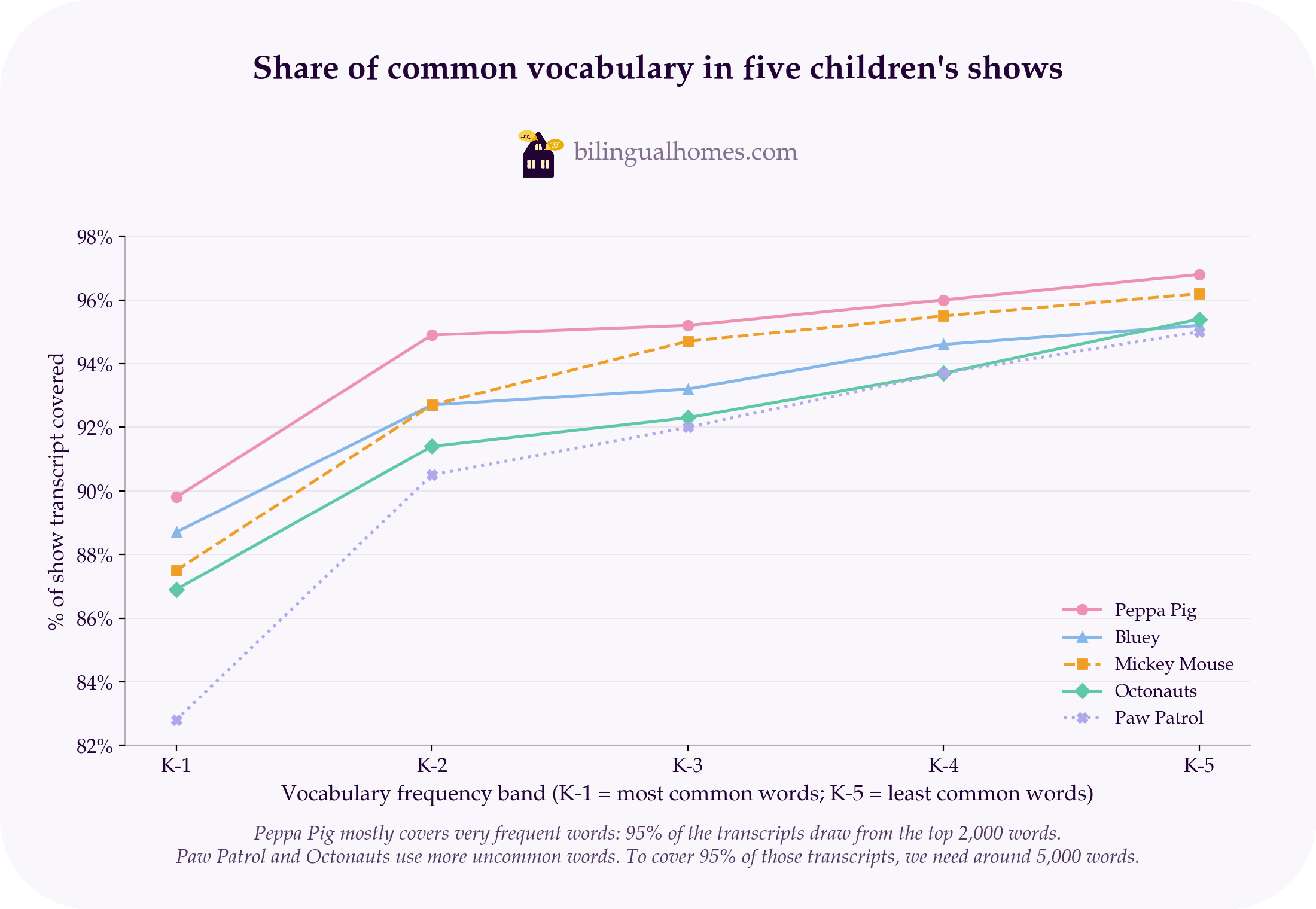
Peppa Pig has the most common words of all: 95% of its dialogue is drawn from the basic 2,000 words. Paw Patrol and Octonauts use more infrequent words than the other shows. The most frequent 2,000 words cover only about 90-91% of these shows, and around 5,000 words are needed to cover 95% of the transcripts.
The shows differ mostly in how much the most frequent words cover. As we move from common to more uncommon words, the shows differ less, but we see that Peppa Pig has the most common vocabulary all the way. Interesting side note: Peppa Pig also has the shortest sentences of all, with around 4 words on average compared to 5-6 words in the other shows.
Each show has its own vocabulary profile
Besides word frequency, the shows also differ in the type of words they offer, and especially in how concrete these are. Concreteness measures how easily a word can be pictured or sensed; puddle scores high because you can see it, while imagination scores low because you can’t. Concrete vocabulary is usually easier to learn for children, because it can be paired with what they see.
Lextutor rates words from 1 (abstract) to 5 (concrete). Peppa Pig scores highest (3.31), which is no surprise considering it’s about everyday things like mud and boat. Octonauts scores lowest (3.12), probably because it leans more on conceptual words like explore and habitat. (By the way, 3.12 vs. 3.31 might seem like a small difference, but for concreteness this is a meaningful gap.)
We also see these differences when we look at which lower-frequency words each show contains. These were some of the most-often repeated words beyond the 3,000 band:
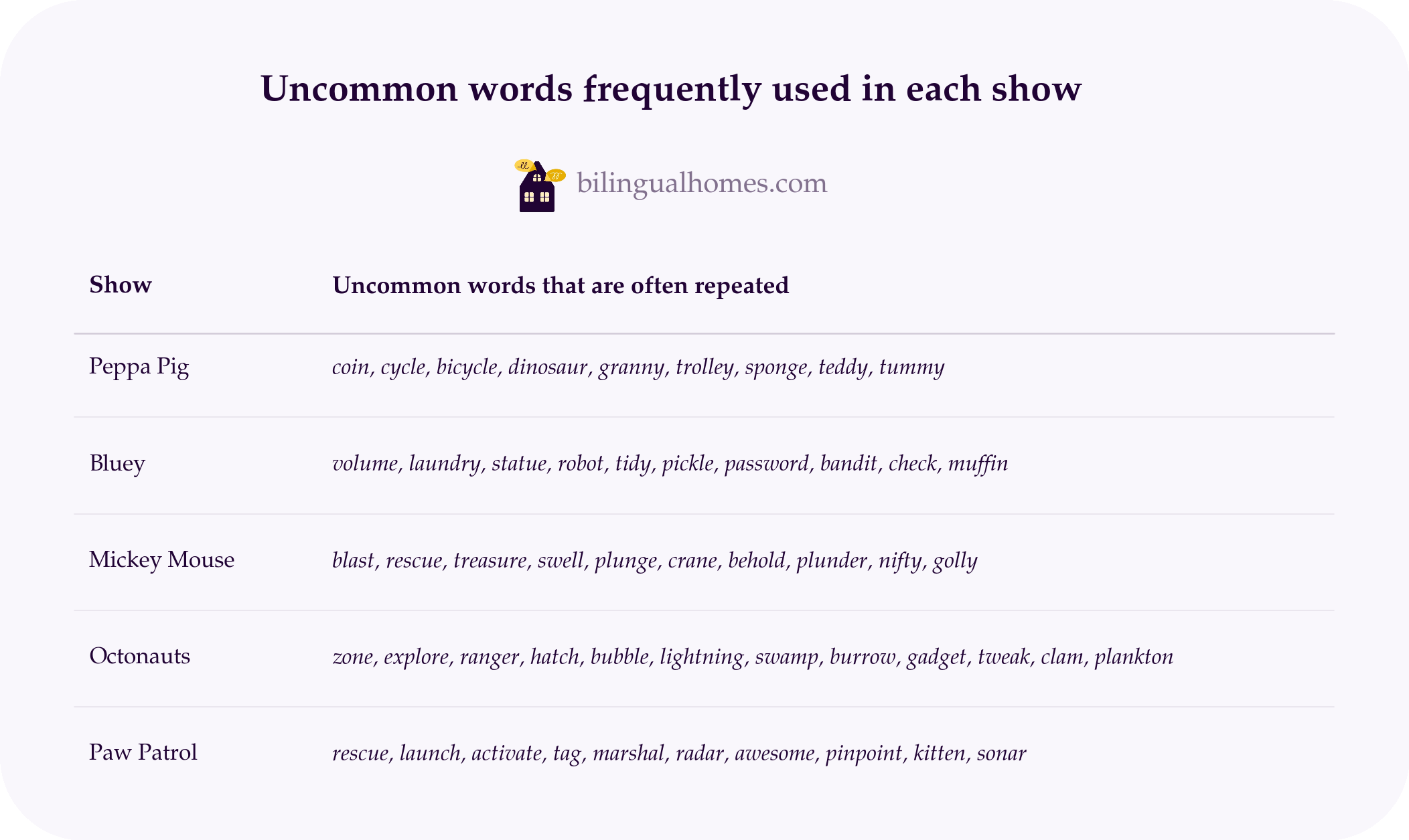
So even though these shows don’t differ a great deal in how many uncommon/new words they cover, the type of words will differ. We see scientific words in the Octonauts, concrete words in Peppa Pig, adventurous action words in Paw Patrol, household words in Bluey, and some classic words in Mickey (swell, behold, nifty, golly).
The takeaway for parents
The data suggests that some shows are easier than others language-wise, lending them better for early learners. Of the five shows analyzed here, Peppa Pig appears to be best for starting learners, as it covers mostly words that are common and concrete, and it introduces these in very short sentences. Other shows will introduce kids to more unknown words; in this analysis, this was true for Octonauts and Paw Patrol. Besides the number of new words that shows introduce, the type of words can be different (think classic words in Mickey Mouse versus sealife vocabulary in Octonauts).
At the same time, the choice between popular shows matters less than we may sometimes fear. In the end, all five shows analyzed here mostly offer common words, presented in short sentences.
A few things probably matter more than which specific show is on:
- whether you watch a show together and talk about it. Active co-viewing (asking questions, naming objects, repeating words) can make input interactive and language rich. Rich input is consistently a strong driver of bilingual language learning, and quality of input often matters more than quantity.
- whether the language exposure is varied. A single show, watched repeatedly, will reinforce a narrow slice of vocabulary regardless of which show it is. Try varying between shows to introduce your child to a range of words, accents, and speeds.
- what else your child is doing. Reading, conversation, and play are the foundations of language development. Screentime can be a supplement, but not a substitute. Think of things your child already likes to do, and see if you can do these in the home language together. Whether it’s reading books, playing games, making up stories, or creating a podcast; every moment of active language use counts.
This analysis was based on transcripts of around 8,000 words per show (covering multiple episodes of each), processed through Lextutor’s Compleat VocabProfile against the BNC-COCA frequency lists. Completed in June 2026.